
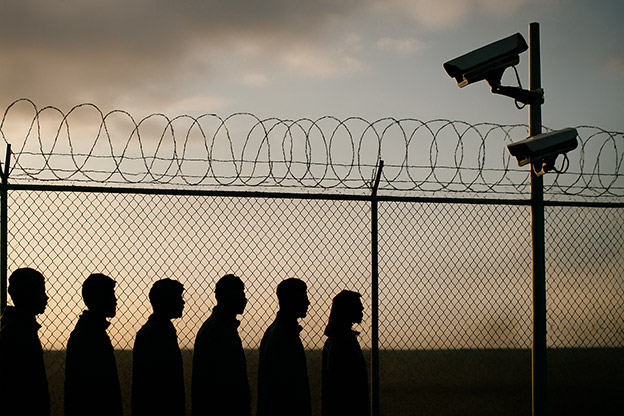
The management of borders represents a critical point where state authority meets human rights and national security concerns. Borders in both the United States and South Africa serve as enforcement areas that test constitutional law boundaries and state authority limits through ethical governance challenges.
[Some extracts below, read the full opinion as published on the Daily Maverick]
Despite the existence of strong constitutional frameworks, borders often emerge as zones where power is exercised with minimal oversight and have increasingly become the subject of heated debates under the pressure of opposing interests. Judicial mechanisms offer post-facto challenges to abuse, but don’t deter injustice from occurring before any intervention takes place.
At stake are not only questions of territorial control, but fundamental civil liberties. While judicial mechanisms exist to challenge abuse, their retrospective nature means infringement is effected before remedy is available.
Border agents routinely make major impactful decisions, often without sufficient legal grounding.
While the Constitution guarantees rights to both citizens and non-citizens, the implementation at borders of those rights remains inconsistent. Legal training should be a vanguard defence against such inconsistency, focusing not only on the technicalities of immigration law but also on values such as proportionality, rationality and dignity, all central to South Africa’s constitutional vision.
Both the US and South Africa must invest not only in infrastructure but in human capital. Agents must be trained to understand not only how to detect threats, but how to respect rights. Performance metrics should include not just seizures or interdictions, but fair treatment, procedural integrity and respect for dignity.
Border zones are not places outside the law. They are “stress tests” for democracy and constitutionalism. In South Africa and the United States alike, the challenge is not whether the state can exercise power at the border, but how that power is constrained, overseen and made just.
Legal training, transparency and accountability are not luxuries; they are the foundation of legitimate enforcement. As Cato’s Letters reminds us, liberty depends not only on institutions but on “eternal vigilance.